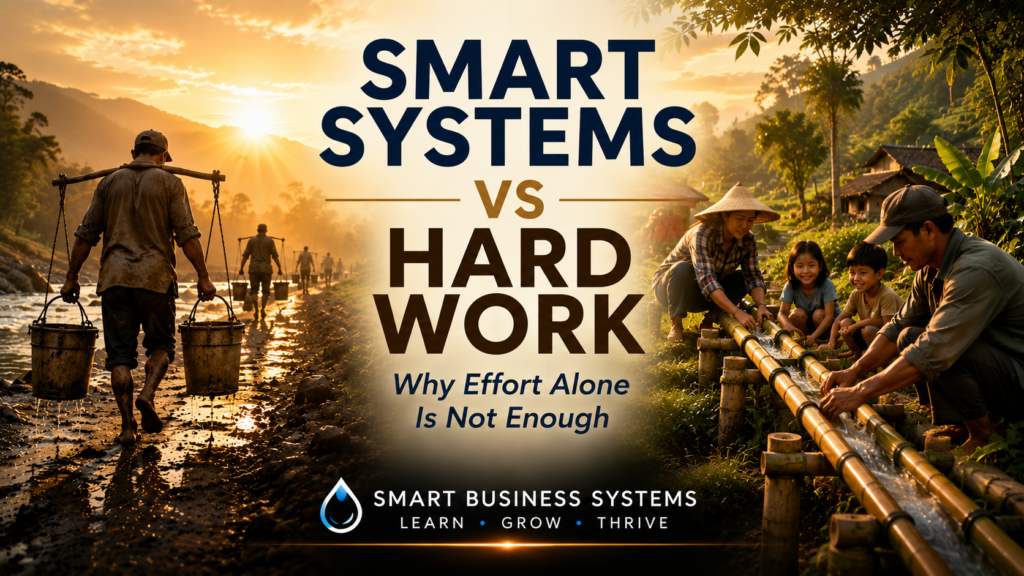
Why Effort Alone Is Not Enough
Most people believe success is primarily a result of hard work.
Work harder.
Wake up earlier.
Push more.
Do more.
At first glance, this advice seems reasonable. Effort matters. Discipline matters. Persistence matters.
But there is a hidden problem.
Hard work alone does not guarantee progress.
Many people spend years working tirelessly while achieving only modest results. Others seem to accomplish more with less stress, fewer hours, and greater consistency.
The difference is often not effort.
The difference is systems.
The Limits of Hard Work
Imagine two people trying to fill a large container with water.
The first person carries buckets from a nearby river all day long.
The second person spends time building a simple pipeline.
At the beginning, the first person appears more productive. They are moving constantly. They are busy. They are working hard.
The second person may even look inefficient.
But over time, the pipeline becomes more valuable than the buckets.
The first person depends on continuous effort.
The second person benefits from a system that keeps producing results.
Business works the same way.
Activity Is Not the Same as Progress
One of the most common traps in modern work is confusing activity with achievement.
Answering emails.
Attending meetings.
Managing small emergencies.
Constantly reacting to problems.
These activities create the feeling of productivity.
Yet many businesses remain trapped in the same cycle month after month because they never create systems that reduce friction and improve efficiency.
Being busy is easy.
Building systems requires thinking.
What Is a System?
A system is a repeatable process designed to produce a predictable result.
Examples include:
- A documented onboarding process for new clients.
- A standardized workflow for content creation.
- A financial review routine performed every month.
- Automated reminders for important tasks.
- Templates for recurring communications.
Systems transform knowledge into consistency.
They reduce mistakes.
They save time.
Most importantly, they allow progress to continue even when motivation fluctuates.
Small Systems Create Big Results
Many people imagine systems as complex structures used only by large corporations.
In reality, most effective systems begin as simple solutions.
A checklist.
A calendar routine.
A shared document.
A template.
A habit.
These small improvements often create results far beyond their size.
This idea closely reflects what we call The Drop Philosophy.
Just as a single drop can create expanding circles across a calm surface, small systems can generate lasting improvements throughout an entire business.
The Compound Effect of Better Systems
When a system saves ten minutes each day, the benefit seems insignificant.
But over weeks, months, and years, the effect compounds.
The same principle applies to:
- Reduced errors.
- Faster communication.
- Better decision-making.
- Improved customer experience.
- More consistent execution.
Great organizations are rarely built through heroic effort alone.
They are built through the accumulation of effective systems.
Building Before Scaling
One of the biggest mistakes entrepreneurs make is trying to grow before creating structure.
Growth amplifies everything.
Good systems become more valuable.
Bad systems become bigger problems.
Before seeking more customers, more traffic, or more opportunities, it is often wise to ask:
“Can my current processes handle growth efficiently?”
If the answer is no, the next priority may not be expansion.
It may be improvement.
Final Thoughts
Hard work remains essential.
No system can replace commitment, responsibility, or persistence.
However, effort becomes dramatically more powerful when guided by well-designed systems.
Success is not only about working harder.
It is about creating conditions where your work continues generating value long after the effort has been invested.
That is the power of systems.
And that is how small improvements become meaningful transformations.